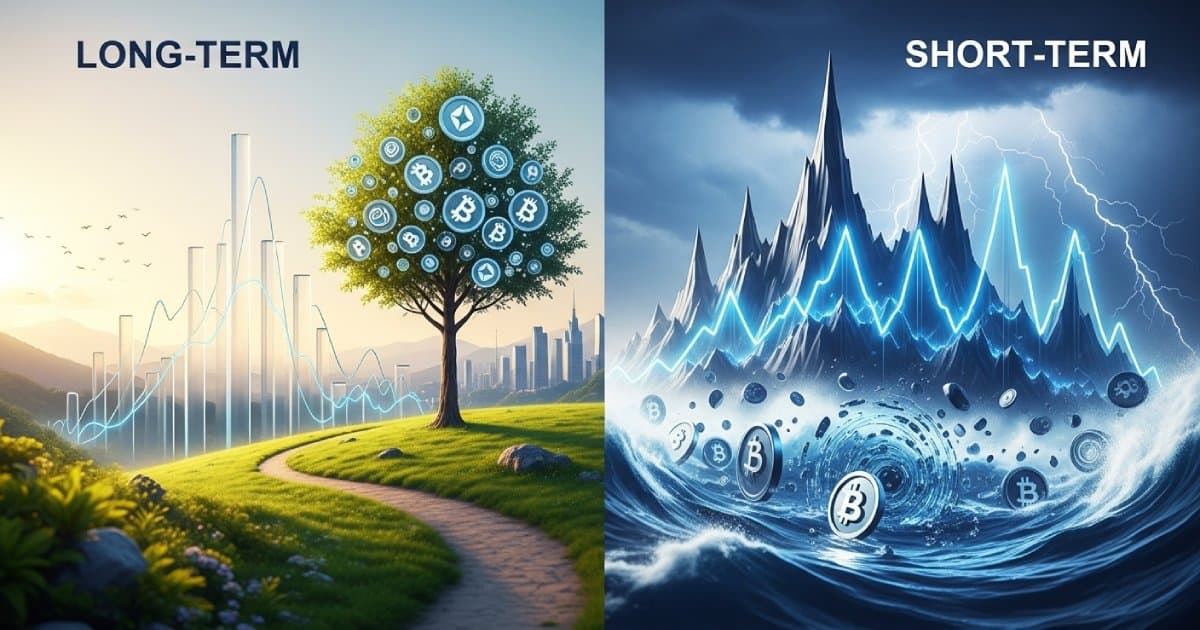
Long-Term vs. Short-Term Crypto Investing: Which Strategy Is Right for You?

The world of cryptocurrency investing offers a spectrum of opportunities, but success often hinges on choosing a strategy that aligns with your goals, risk tolerance, and personality. The most fundamental decision you'll make is your time horizon: are you in it for the long haul, or are you looking to capitalize on short-term market movements? This choice separates investors into two broad camps: long-term holders and short-term traders.
Understanding the nuances, benefits, and risks of each approach is critical before you invest your first dollar. This comprehensive guide will dissect long-term vs. short-term crypto investing, providing the insights you need to make an informed decision and navigate the volatile crypto landscape with confidence.
What is Long-Term Crypto Investing (HODLing)?
Long-term crypto investing, famously known in the community as "HODLing," is a strategy centered on buying and holding digital assets for an extended period, typically one year or more. The term "HODL" originated from a misspelled post on a Bitcoin forum and has since been adopted as a mantra for holding on through market volatility. The core philosophy is a belief in the fundamental value and future potential of a cryptocurrency project, its technology, and its role in the evolving digital economy.
Long-term investors are less concerned with daily price fluctuations. Instead, they focus on the bigger picture, betting that their chosen assets, such as Bitcoin (BTC) or Ethereum (ETH), will appreciate significantly over several years. This approach is akin to traditional value investing in the stock market.
Pros of Long-Term Investing
- Reduced Stress: By not reacting to every market dip or spike, long-term investors can avoid the emotional rollercoaster that often accompanies active trading.
- Potential for Substantial Gains: Historically, major cryptocurrencies like Bitcoin (BTC) have delivered immense returns to those who held them through multiple market cycles.
- Lower Time Commitment: Once the initial research is done and the investment is made, HODLing is a relatively passive strategy that doesn't require constant market monitoring.
- Simpler Tax Reporting: In many jurisdictions, long-term capital gains are taxed at a lower rate than short-term gains, which can lead to significant savings.
Cons of Long-Term Investing
- Capital is Locked Up: Your funds are tied up for years, meaning you can't easily access them for other opportunities or emergencies without potentially selling at an inopportune time.
- Risk of Project Failure: The crypto space is still nascent. A project that seems promising today could become obsolete or fail over the long term due to competition, technological flaws, or regulatory issues.
- Missed Short-Term Opportunities: While HODLing, you will miss out on chances to profit from short-term price swings and market volatility.
- Requires Strong Conviction: It takes significant emotional fortitude to hold onto your assets during severe bear markets, where prices can drop by 80% or more.
Best Practices for Long-Term Investors
To succeed as a long-term investor, a disciplined approach is essential. Start with deep fundamental analysis, researching a project's whitepaper, development team, tokenomics, community, and real-world use case. A popular strategy is Dollar-Cost Averaging (DCA), where you invest a fixed amount of money at regular intervals, regardless of the price. This mitigates the risk of investing a lump sum at a market top. Finally, prioritize security. Store your crypto in a secure hardware wallet that you control, not on an exchange, to protect it from hacks and theft.
What is Short-Term Crypto Trading?
Short-term crypto trading is the antithesis of HODLing. It involves buying and selling cryptocurrencies over short time frames—from minutes (scalping) to days (day trading) or weeks (swing trading)—to profit from price volatility. Traders are not primarily concerned with a project's long-term fundamentals. Instead, they rely heavily on technical analysis (TA), studying price charts, patterns, and indicators to predict future price movements.
A short-term trader's goal is to accumulate more of their base currency (like USD or BTC) by successfully executing numerous trades. It is an active, high-stakes discipline that requires significant skill, time, and emotional control.
Pros of Short-Term Trading
- Potential for Quick and Frequent Profits: Successful traders can generate regular income by capitalizing on the market's constant fluctuations.
- Active Market Engagement: Trading keeps you deeply involved with market dynamics and can be intellectually stimulating.
- Capital is Liquid: Your funds are not locked up for long periods, allowing you to move between different assets and opportunities quickly.
Cons of Short-Term Trading
- High Stress and Emotional Drain: Constantly monitoring charts and managing open positions can be mentally exhausting and lead to impulsive decisions.
- Significant Time Commitment: Successful trading is a full-time job for many. It requires hours of research, analysis, and execution daily.
- Higher Transaction Fees: Frequent trading means accumulating more fees from exchanges, which can eat into profits.
- High Risk of Loss: The majority of new traders lose money. It takes years of practice to become consistently profitable, and a few bad trades can wipe out an account.
- Complex Tax Implications: Tracking and reporting hundreds or thousands of trades for tax purposes can be a nightmare, and gains are often taxed at higher rates.
Common Short-Term Trading Strategies
Traders employ various strategies. Day trading involves opening and closing positions within the same day, ensuring no positions are held overnight. Swing trading aims to capture "swings" in price over several days or weeks. Scalping is the most rapid form, where traders aim for tiny profits on numerous trades made over minutes or even seconds. All these strategies depend on a solid understanding of technical indicators like Moving Averages, RSI (Relative Strength Index), and MACD (Moving Average Convergence Divergence).
Key Differences: Long-Term vs. Short-Term
Choosing your path requires understanding the core distinctions between these two philosophies.
Time Horizon & Mindset
The most obvious difference is the time frame. Long-term investors think in years, focusing on a project's adoption and technological maturation. Short-term traders think in minutes, hours, or days, focusing on market sentiment and price action. The investor's mindset is one of ownership and partnership with a project, while the trader's mindset is one of exploiting temporary market inefficiencies.
Risk Profile
Both strategies are risky, but the nature of the risk differs. Long-term investors face the risk of a project's fundamental failure or the entire crypto market not reaching its potential. Short-term traders face the immediate risk of market volatility, where a sudden price crash can lead to massive, rapid losses. They must be adept at risk management, using tools like stop-loss orders to protect their capital.
Required Skills & Effort
Long-term investing is front-loaded with effort in research (fundamental analysis) but becomes passive afterward. Short-term trading requires continuous effort in technical analysis, chart monitoring, and trade execution. It demands discipline, quick decision-making, and a deep understanding of market psychology.
Psychological Aspect
HODLing requires patience and the conviction to weather brutal bear markets without panic selling. Trading requires emotional detachment and the discipline to stick to a strategy, cut losses quickly, and not let fear or greed dictate actions. Both are psychologically demanding in their own unique ways.
Which Strategy is Right for You?
There is no universally "better" strategy. The right choice depends entirely on your individual circumstances.
- Assess Your Risk Tolerance: How would you react if your portfolio dropped 50% in a week? If you'd panic sell, short-term trading is likely not for you. If you have a high tolerance for volatility and are skilled at managing risk, trading could be an option.
- Consider Your Time Commitment: Do you have a full-time job and limited free time? A long-term, passive HODL strategy or DCA approach would be more suitable. Active trading demands hours of attention each day.
- Define Your Financial Goals: Are you saving for retirement in 20 years, or are you trying to generate supplemental income this year? Your goals will heavily influence your time horizon.
- Evaluate Your Knowledge and Skills: Be honest about your expertise. If you're new to crypto, starting with a long-term investment in well-established projects like Bitcoin (BTC) and Ethereum (ETH) is a much safer approach than jumping into leveraged day trading.
Many investors also adopt a hybrid approach, dedicating a core part of their portfolio (e.g., 80%) to long-term holds of established assets and using a smaller, speculative portion (e.g., 20%) for short-term trades or investing in newer, riskier projects.
Conclusion
The debate between long-term investing and short-term trading is central to the crypto experience. Long-term HODLing is a strategy of patience and conviction, betting on the fundamental promise of blockchain technology. Short-term trading is a discipline of skill and agility, seeking to profit from the market's inherent volatility. Neither path guarantees success, and both come with significant risks. The key is to engage in self-reflection, understand the demands of each strategy, and choose the one that aligns with your financial goals, lifestyle, and psychological makeup. By doing so, you can build a sustainable approach to navigating the exciting and challenging world of cryptocurrency.
Frequently Asked Questions
HODL is a term derived from a misspelling of 'hold.' It refers to a long-term investment strategy where you buy a cryptocurrency, like Bitcoin (BTC) or Ethereum (ETH), and hold it for an extended period (usually years), regardless of market volatility. The strategy is based on the belief in the long-term fundamental value of the asset.
Short-term crypto trading can be highly profitable for skilled and experienced traders, but it is also extremely risky. The majority of beginners lose money due to high volatility, emotional decision-making, and transaction fees. Profitability requires a deep understanding of technical analysis, disciplined risk management, and significant time commitment.
Dollar-Cost Averaging (DCA) is a strategy where you invest a fixed amount of money into an asset at regular intervals (e.g., $100 every week), regardless of the price. It is an excellent strategy for long-term investors because it reduces the risk of investing a large sum at a market peak and smooths out the average purchase price over time.
Short-term traders need several tools: a reliable cryptocurrency exchange with low fees and high liquidity, advanced charting software like TradingView to perform technical analysis, a trade journal to track performance, and news aggregators to stay informed about market-moving events. Many also use portfolio trackers and tax software.
Tax implications vary significantly by country. However, in many places like the United States, there's a distinction between long-term and short-term capital gains. Assets held for over a year (long-term) are often taxed at a lower rate than assets sold within a year (short-term), which are typically taxed as regular income. Short-term traders face a higher tax burden and more complex reporting.
Yes, many investors use a hybrid or 'core-satellite' approach. They allocate the majority of their portfolio (the 'core') to long-term holds of established cryptocurrencies like Bitcoin (BTC). They then use a smaller portion (the 'satellite') for more speculative, short-term trades or investments in newer, riskier altcoins. This balances long-term growth potential with opportunities for short-term gains.
The primary risks for long-term investors include: 1) Fundamental Risk: The project you invest in could fail due to flawed technology, poor management, or lack of adoption. 2) Systemic Risk: The entire cryptocurrency market could face a catastrophic event or fail to gain mainstream acceptance. 3) Custody Risk: Losing access to your private keys or having your assets stolen from an exchange. 4) Opportunity Cost: Your capital is tied up and cannot be used for other investments.
For long-term holding, investors typically focus on established projects with strong fundamentals, large networks, and clear use cases, such as Bitcoin (BTC) and Ethereum (ETH). For short-term trading, traders often look for assets with high volatility and liquidity, which can include both major coins and more speculative altcoins. The choice depends on the trader's specific strategy and risk appetite.